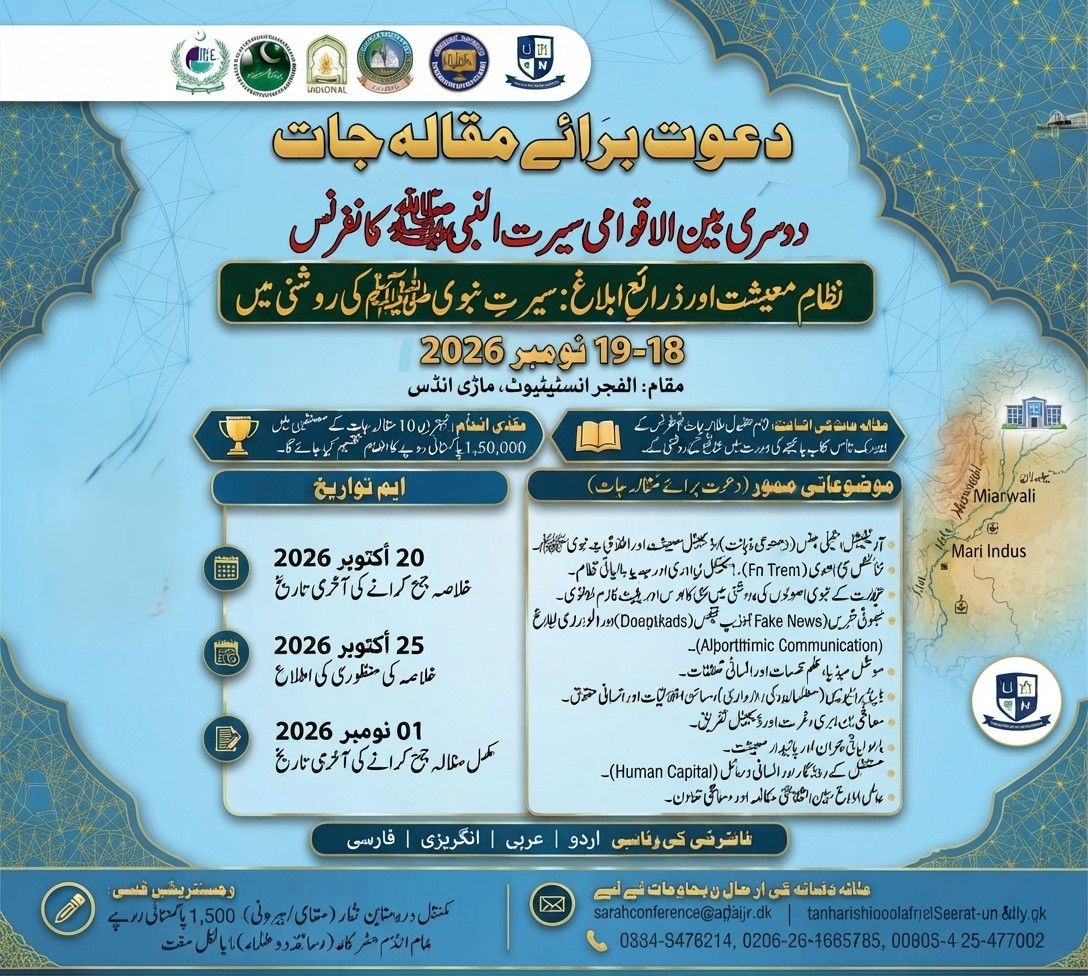
2nd International Seerah Conference 2026
Theme: Economic Systems and Media in the Light of the Prophetic Seerah ﷺ
18–19 November 2026
Organized by Al-Fajr Institute of Higher Studies, Mari Indus, Mianwali, Pakistan
Introduction
The world is experiencing significant changes in economic systems and means of communication. The expansion of digital economies, artificial intelligence, global trade, and modern media has created new opportunities for human development. At the same time, these developments have raised serious questions about economic justice, social inequality, ethical business practices, the responsible use of technology, and the credibility of information.
In this changing environment, the life and teachings of Prophet Muhammad ﷺ offer valuable guidance for addressing contemporary challenges. The Prophetic Seerah presents principles of justice, honesty, fairness, accountability, human dignity, and social responsibility. These principles are not limited to individual conduct but also provide an ethical foundation for economic relationships, public communication, and the well-being of society.
The economic practices of the Prophet Muhammad ﷺ emphasized fair trade, the protection of rights, the prevention of exploitation, and care for vulnerable members of society. Similarly, his approach to communication was based on truthfulness, wisdom, dialogue, mutual respect, and the responsible transmission of information. These teachings remain relevant in an age shaped by digital banking, electronic commerce, social media, artificial intelligence, and rapidly changing patterns of global communication.
Recognizing the importance of these issues, Al-Fajr Institute of Higher Studies, Mari Indus, Mianwali, is organizing the 2nd International Seerah Conference 2026 under the theme “Economic Systems and Media in the Light of the Prophetic Seerah ﷺ.”
The conference aims to bring together scholars, researchers, academics, students, and professionals from different disciplines to examine how the principles of the Prophetic Seerah can contribute to contemporary debates on economic systems and media ethics. It seeks to encourage meaningful discussion between Islamic scholarship and modern academic disciplines, particularly economics, business, information technology, media studies, and the social sciences.
Through scholarly presentations, research papers, and academic discussions, the conference will provide an opportunity to explore practical ways of applying the values of the Prophetic Seerah to modern economic and communication challenges.
Central Question of the Conference
How can the principles and practices of the Prophetic Seerah ﷺ guide the development of just, inclusive, and ethical economic systems and promote responsible communication in an increasingly digital and interconnected world?
Key Questions of the Conference
- How can the economic principles of the Prophetic Seerah ﷺ provide guidance for addressing contemporary challenges such as economic inequality, poverty, financial injustice, and the ethical use of modern economic technologies?
- How can the teachings and communication practices of Prophet Muhammad ﷺ guide the responsible use of modern media, social media, and artificial intelligence while promoting truthfulness, ethical communication, and peaceful coexistence?
Objectives of the Conference
The conference seeks to achieve the following objectives:
- To explore the relevance of the Prophetic Seerah to contemporary economic systems, business practices, and modern means of communication.
- To promote research on economic justice and social welfare by examining Prophetic principles concerning fair trade, wealth distribution, poverty alleviation, and the protection of human rights.
- To examine emerging economic challenges, including digital banking, financial technology, electronic commerce, artificial intelligence, and the changing nature of employment, from the perspective of Islamic ethics.
- To highlight the importance of ethical communication by exploring the Prophetic teachings of truthfulness, responsibility, wisdom, and respect in relation to modern media and digital platforms.
- To encourage critical discussion on misinformation and media responsibility, particularly the challenges associated with fake news, deepfakes, digital privacy, and artificial intelligence.
- To promote interdisciplinary academic collaboration among scholars of Islamic studies, economics, business administration, computer science, media studies, and other relevant disciplines.
- To strengthen national and international academic cooperation by providing a platform for scholars and researchers to exchange ideas, share research findings, and develop new areas of scholarly inquiry.
- To encourage young researchers and students to engage in research on the contemporary relevance of the Prophetic Seerah and its contribution to addressing modern social and economic challenges.
- To develop practical and research-based recommendations that may help educational institutions, policymakers, businesses, and media organizations promote justice, ethical responsibility, and human welfare.
Expected Outcomes
The conference is expected to contribute to a deeper understanding of the relationship between the Prophetic Seerah and contemporary economic and communication systems. It will encourage interdisciplinary research, strengthen cooperation among academic institutions, and provide opportunities for emerging scholars to present their work. The discussions and research presented at the conference may also contribute to academic publications, future research collaborations, and practical recommendations for promoting ethical economic practices and responsible media communication.
Above all, the conference seeks to demonstrate that the Prophetic Seerah ﷺ remains a valuable source of guidance for addressing the challenges of modern society while promoting justice, human dignity, peaceful coexistence, and collective well-being.